Here at I Love A Clean San Diego, we have a lot to be thankful for. Our programs have been growing, along with our staff, and there just generally seems to be a positive and enthusiastic buzz around the office. With the holiday season upon us, we’d like to take a few minutes to share some of the things that we are thankful for this year.
I’m thankful for youth who become inspired when they see how they can make a difference to conserve and enhance San Diego.
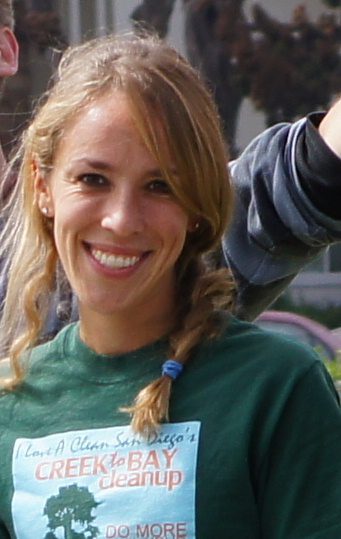
I’m thankful to all San Diegans who volunteer their time to make San Diego a cleaner city.
I’m thankful for email receipt options that many stores are now providing. No more paper waste!
I’m thankful for plastic bag bans in California and all over. They reduce trash and encourage the use of reusable bags.
This year, I’m thankful for cleaner beaches and canyons.
I’m thankful for the partnerships we have in the community that allow us to reach more people with our environmental programs.
I’m thankful for 4 more years of an environmentally progressive administration!
I’m thankful for the paint care program, which has made paint disposal much easier for San Diegans.
I’m thankful for increased volunteerism in 2012 amongst San Diego County residents for ILACSD programs and events.
I’m thankful for the carbon emission limit certificates that the state auctioned off. Carbon credit/carbon tax, here we come!
This year, I’m thankful for the results of the 2012 presidential election and sustainable initiatives for the next four years.
Today’s post comes from ILACSD’s Environmental Educator, Monica Rosquillas!
Last Thursday, November 15th, was America Recycles Day. The County of San Diego and I Love A Clean San Diego staff celebrated the day with students at Barnett Elementary School in Ramona. We arrived bright and early to set up the EnviroFair which included booths, games, and activities for kindergarteners through 5th graders participated in throughout the day. The Solana Center, Ramona Disposal, and the County of San Diego Office of Education’s Splash Lab were also there with educational activities and exhibits that displayed all the cool things about recycling. This was an all-day event, students came in early in the morning and the last group left right before the bell rang, announcing the end of the school day and the start of the After-School Cleanup.
Students learning about composting
I was not expecting America Recycles Day to be so educational and fun! The students and I had a chance to spend time at each of the booths and activity centers where there were many activities including a fast game of recycle relay where students used their speed and knowledge about recyclables, compostable items, and hazardous waste, a composting exhibit (worms and all), toys and neat decorations made from recycled materials. There was even a real recycling truck from Ramona Disposal! Students got to see firsthand how recycling trucks work, and I was very impressed by the questions students were asking our friends at Ramona Disposal like: Do the trucks run on diesel or gasoline? What happens to the recyclables after they get picked up at my house? How many pounds of recyclables are collected each day? And of course, many wanted to know whether they had ever found anyone hiding in the back of the truck 🙂
Not only did students learn all about recycling, but many also participated in a cleanup held right at their school. There, they were able to apply the knowledge they gained during the EnviroFair by picking up and sorting trash, recyclables, and hazardous waste found around their school. Our community events staff led the cleanup around campus with about 50 students, parents, teachers, and staff who picked Seventy-Five pounds of trash and recyclables! Everyone who participated in the clean-up helped make a cleaner San Diego and prevented that trash from ending up in our waterways. Overall, these kids were awesome, one enthusiastic student told Lexi, our Community Events Coordinator “you know, I would risk my life if it meant a greener Earth”.
At the end of the day I was exhausted, but I felt great about teaching San Diego’s youth the so many great things about recycling, reusing, and reducing! Not to mention having fun and learning so much myself. I’m looking forward to November 15, 2013, but until then, I will be sure to make everyday a recycling day.
Today’s post comes from your clean water ambassador, Captain Wetiquette.
Deep frying your turkey this Thankgiving? While it might lead to a delicious meal, what are you going to do with all that used cooking oil? Luckily, WasteFreeSD.org has the 411 on what those of us in the trash industry refer to as F.O.G. (that’s fats, oils, and grease for all you non-trash talking folks).
With the holiday season drawing near, let this serve as a reminder that fats, oils, and grease from cooking should not be poured down kitchen sinks or drains! Instead, residents should accumulate their used cooking oil for proper disposal at a local collection facility. To find the closest drop off location, residents are encouraged to visit WasteFreeSD.org
When cooking oil is discarded into your kitchen sink, it accumulates inside the sewer pipes making it difficult for wastewater to flow freely to the wastewater treatment plant. This includes wastewater draining from toilets and showers. When wastewater cannot make its way through the sewer pipes, it overflows into our homes, streets, lawns, and storm drains, eventually making its way to the ocean. These results are the equivalent of a sewage spill, and can cause substantial damage to the local environment. Eww!!
Thankfully, there are a number of collection sites that accept cooking oil from the public in San Diego County. For unincorporated County residents, there are collection sites at Ramona Disposal, as well as EDCO facilities in San Marcos and Lemon Grove. City of San Diego residents may take their used cooking oil to Miramar Recycling Center, provided that it is less than 30 quarts. There is no fee associated with recycling used cooking oil and some facilities are even able to turn this used cooking oil into fuel for cars and other machines.For more information on these centers, visit WasteFreeSD.org.
Today’s blog post comes from our Director of Development & Marketing, Morgan Justice-Black.
I know what you’re thinking…someone please spare me from another voting campaign!
While the November elections might be over for some, things are just heating up for us here at I Love A Clean San Diego. We’ve been selected as one of eight environmental nonprofits battling it out for a $25,000 donation from San Diego Gas & Electric. That’s right, we’ve got a 1 in 8 shot to win enough money to educate an additional 4,000 kids this school year! But we need your help to get there!
Yes, I understand your slight fatigue from being asked day after day to participate in someone’s online voting campaign. Whether it’s cutest baby (ok, we get it, you think that your kid is the cutest one out there), to pet of the week, to talent competitions, there is no lack of requests for online voting. In fact, even the term “voting” makes me slightly nauseous after enduring months of campaigning leading up to the November 6th election.
Please take a moment to do these quick and easy steps to help ILACSD win this thing!
Remember, you can vote once a day from now until December 6th!
And in case you need a little more encouragement, take it from this guy who at 8 years old is pretty insistent on saving the environment. At an ILACSD cleanup he told one of our staff members “You know, I would risk my life if it meant a greener earth!” We aren’t asking you to risk your life, just take a few moments of your time to vote for ILACSD every day!
At 8 years old, he’s ready to risk his life for a healthier environment!
Today’s post comes from the newest member of the ILACSD team, Erika Bjorkquist our Education Coordinator!
30 days, 14 presentations, 3 community events.
Two months ago, I would never have guessed that I would be sitting at a desk surrounded by recycling posters, maps of San Diego Watersheds, and aerial photographs of human sand designs. Two months ago, I was visiting my grandmother in Oregon, on a road trip from New Jersey to San Diego. I checked my email and Facebook, found nothing of importance, then progressed to what I had been putting off: the burden of finding a job. I was about to give in to the temptation of tomorrow when I found it, I Love A Clean San Diego in bold: Education Coordinator, full time, application due Friday. Tomorrow became sparkling and bright.
Fast forward. I have now been the Education Coordinator at I Love A Clean San Diego for 30 days (I just received my business cards, so I’m official!). In that time I have come in contact with thousands of people, old and young, at cleanups, community events, and education presentations. ILACSD is true to their mission when they include words like “example” and “actively conserve.” My favorite part of the job is interacting with students during our classroom and assembly education programs. In the past, I had participated regularly in ILACSD cleanups, but had no idea that they had an education component, so I have had a lot to learn!
You might be like me and know a lot about ILACSD’s cleanups but aren’t as familiar with our education programs. ILACSD has 17 different education programs catering to students from kindergarten to 12th grade. We are fortunate enough to partner with agencies and organizations throughout San Diego, so most of our programs are free!
Students love to learn with our EnviroScape watershed model!
Last year, we presented over 500 programs to a total of 30,835 students. PHEW! Obviously, one person can’t do all of that work, so we have an EDventurous Education Department made up of 5 people: our Director, Samantha, Environmental Educator, Monica, part-time Educators, Erin and Kate, and me! Each day, we go out to schools all over San Diego County to teach students about the environment. (You can learn more about the whole ILACSD team here)
Our programs typically span an hour and, depending on the program, content ranges from conservation to watersheds. If you are teaching about recycling, we gotcha. Pollution? No problem! Landfills? Don’t fill up your schedule. I could go on, but basically, our programs cover a range of subjects that are current and relevant to rural and urban San Diego. In the past month, I have been in all corners of the County, from Boulevard, San Ysidro, Julian, to Oceanside; the environments and demographics change considerably, but I am always greeted by the same enthusiasm because everyone loves a clean San Diego.
If you are interested in or have questions about our programs, don’t hesitate to call me at 619.704.2777 or email at ebjorkquist@cleansd.org. I look forward to hearing from you!
Today’s post comes from ILACSD’s Marketing Intern, Brian McComb, and continues our theme from yesterday on how you can protect our local waterways.
As this summer has given us one of the worst droughts in recent US history, coupled with the ongoing plague of droughts in Africa and Eastern Europe, there is perhaps no better a time to focus on water!
So do you know where your water comes from? Chances are you are actually sipping on water that came from your local river or stream. In fact American Rivers – a leading organization working to protect and restore the nation’s rivers and streams – estimates that almost 65% of drinking water across the United States comes from rivers and streams. Unfortunately they also estimate that nearly 40% of all rivers and streams in the U.S. are too polluted for even fishing or swimming.
So what is a watershed? Well our rivers and streams are only the most visible part of a much larger system, a system that connects our land to our water in ways we don’t usually realize. So as water becomes more and more important to our world’s ever-expanding population, the protection of watersheds becomes an ever more pressing matter.
Okay, so then what is a watershed? In essence, a watershed is the area of land where all the water (whether falling as rain or pumped out of the ground) eventually drains towards, meanders through, or somehow filters back to collect and replenish a common water source. It’s a swath of topography that contributes to a common water table, and it relies completely upon itself to sustain the water supply.
Watershed In Action
One of the important things to realize about watersheds, is that they include large areas of land around a visible water sources. Even if you are miles away from the nearest stream, what you do to the land in your area can still have a huge impact on the water. Chemicals dumped on desert rocks can seep through the ground and enter the same aquifer that feeds a far away stream. Garbage tossed into a seemingly dry gully can be swept away when a rare rainstorm turns that gully into short-lived class IV white water rapids. The point is, although trash and debris might be tossed far away from a water source and are no longer in your “backyard,” that debris may still end up contaminating your tap water.
Now not all watersheds are created equal. Some watersheds may feed into lakes, while others drain into a system of streams and rivers that eventually end up in the ocean. Some watersheds may cover little more than a hundred miles total (i.e. the San Diego watershed), while others (like the Mississippi watershed system) can span hundreds of thousands of miles.
Mississippi River Watershed
Watersheds come in all shapes and sizes across the world and are not limited by state or national boundaries. In the continental US alone there are over 2,100 watersheds. Though there are larger and smaller watersheds, no watershed is too large to be impervious to human harm.
Watersheds are extremely important to our daily lives as well as our future. To learn more about watersheds, check out resources like water.epa.gov.
Also, through I Love A Clean San Diego’s High School Watershed Education Program, we offer FREE watershed presentations to high schools within the City of San Diego and the unincorporated areas of the County of San Diego.
Our standards-based presentations focus on local watersheds and how pollution affects human health, as well as the health of local ecosystems. Help us keep our watersheds clean and healthy and empower students to be environmental stewards in their communities. These presentations are flexible to best fit your school’s schedule – schedule just a few classes or an entire day.
For more information or to schedule a presentation for your organization or club, please contact our Education Coordinator, Erika, at ebjorkquist@cleansd.org!
Today’s post comes from ILACSD’s Community Events Intern, Taylor Goelz!
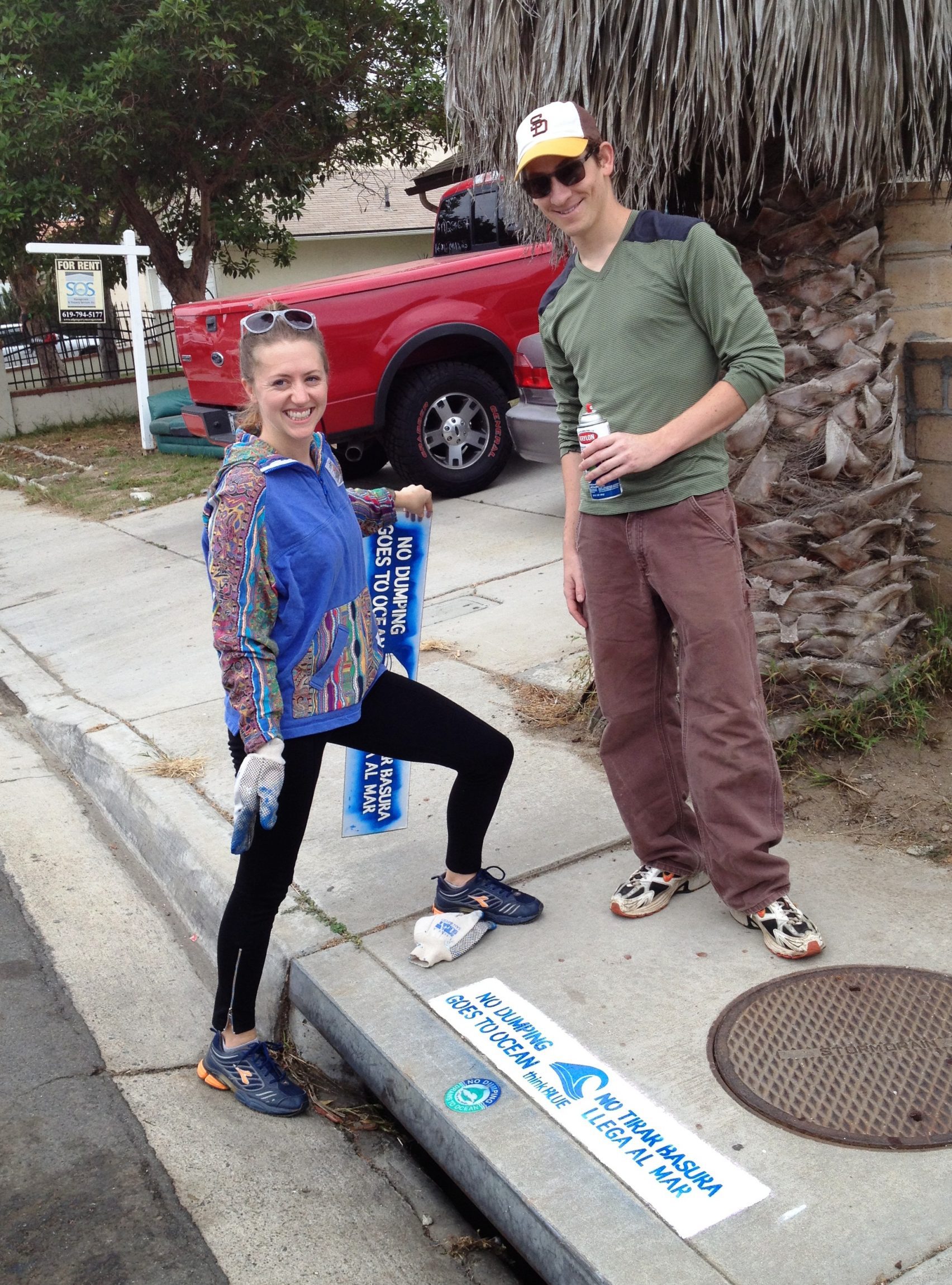
Now that the month of October is over with its cleanups every weekend, we in the office can take a little breather, but not for long! As we mentioned last week, I Love A Clean San Diego hosted two of the Tijuana River Action Month Cleanups (TRAM) during October. Last weekend at the final TRAM Cleanup, along with clearing the Tijuana Watershed of 278 tires and an entire dumpster full of trash, some volunteers participated in our StormDrainStencilingProgram. This volunteer program is so important to the City of San Diego because it helps raise awareness about how you can prevent trash from flowing down stream and polluting our beautiful ocean. We promote Storm Drain Stenciling even more around this time of year because it’s just before the winter rains come in and wash all of the debris and pollutants from our day-to-day activities into local waterways and the ocean.
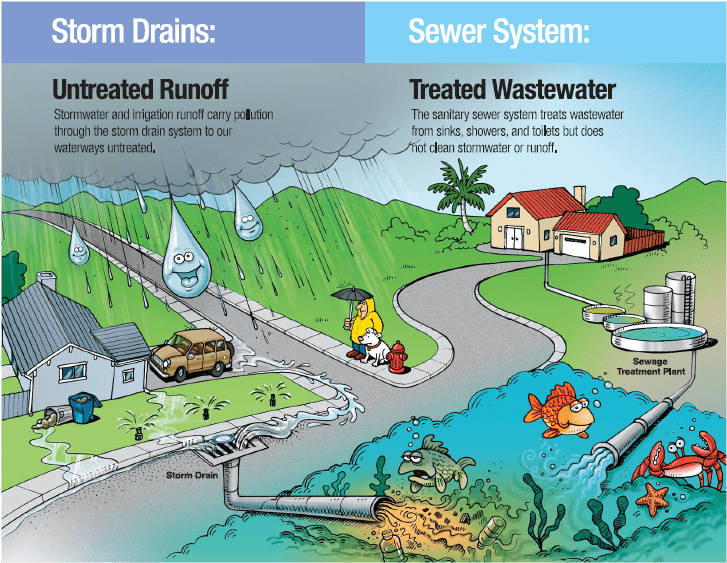
Not many people know that there is a HUGE difference between sewer pipes, like the pipes in your home, and storm drains, a common sight on city streets. Anything that goes into a sewer first goes to a sewer treatment facility where it’s treated before going into the ocean. On the other hand, all the trash, runoff and debris that goes into storm drains isn’t treated, it just goes straight into the ocean as is! Not only does all of this trash in the ocean make a day at the beach less fun, but it also threatens human health and endangers wildlife. You may think that the majority of the trash in the ocean comes from people enjoying a day at the beach, but up to 80% of the pollutants and litter that is found in the ocean came from inland sources and washed down to the ocean via storm drains.
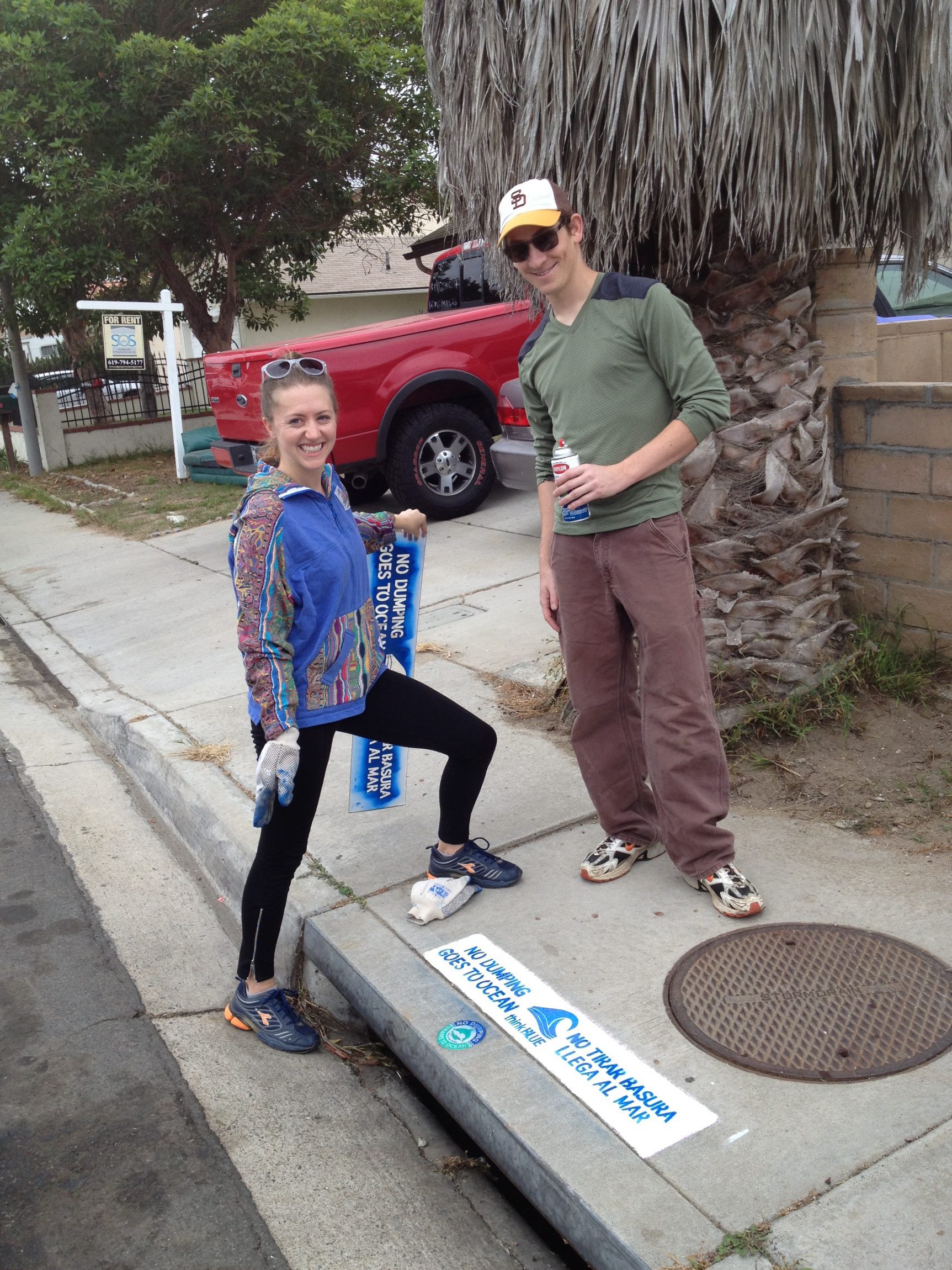
While this is a serious problem, ILACSD and Think Blue, the City of San Diego Storm Water and Transportation Department have a very easy, and fun, way to make sure people know the connection between ocean pollution and storm drains, Storm Drain Stenciling! The premise is simple: you volunteer to go around and stencil a bilingual message on top of a storm drain to create a visible reminder to let people know that anything they dump here will all go straight to our ocean backyard.
To find out more about this unique volunteer program and to schedule a time to pick up a stenciling kit, you can email volunteers@cleansd.org or call us at 619-291-0103. You will need a $25 deposit (cash or check only please) that is entirely refundable if you take good care of the kits and return them in good shape! So here’s a call to arms for all you artistic environmentalists out there, Storm Drain Stenciling is a great way to get the word out about the connection between local waterways and the ocean. Happy stenciling!
Update: with the addition of our last cleanup of the month, sponsored by Beckman Coulter, the grand total for October is 36,000 pounds of trash and debris!
Today’s post comes from ILACSD’s Community Events Coordinator, Lexi Ambrogi!
If you’ve visited the I Love A Clean San Diego office in the past month, there’s a good chance you’ve had to navigate your way through towering stacks of buckets or gotten a good laugh at the mountain of boxes at my desk. Since Coastal Cleanup Day, the ILACSD Community Events department hasn’t had much of a breather—we’ve hosted a cleanup every single weekend in October! Here’s an update on what we’ve been up to.
This month, we co-hosted two cleanups alongside our friends at WiLDCOAST. These events were part of Tijuana River Action Month, a bi-national effort to clean up and protect the Tijuana watershed. We chose locations that are in a particularly high-risk location for debris collection. This area of San Diego lies on a floodplain, and trash from both sides of the border washes into this part of the Tijuana River Valley. Our mission was to remove as much of this trash as possible from the surrounding trails before the winter rains wash it out to the Pacific, where it would be harmful—even deadly—to marine life.
Between these two cleanups, our amazing volunteers pulled 7,940 pounds of trash and 12,660 of recyclables! Trust me, if you want an excuse to skip the gym on a Saturday morning, just come to one of our cleanups. Our volunteers filled up an entire dumpster this weekend in just over two hours. We collected 100 tires from the first TRAM cleanup and another 280 this past weekend—seriously impressive.
We had a fun side project at last weekend’s event; some volunteers elected to participate in Storm Drain Stenciling Day, a program that’s available year-round to ILACSD volunteers thanks to the City of San Diego’s Think Blue. We gave volunteers a stencil with a stormwater pollution prevention message (“No dumping—goes to ocean”), some paint, and a map, and they were off on a treasure hunt around the neighborhoods, looking for drains to mark.
Two weeks ago, ILACSD and the City of Chula Vista hosted the 10th Annual Beautify Chula Vista Dayat four sites throughout the city. 600 volunteers collected 4,200 pounds of trash and recyclables! They also wiped out graffiti and removed 8,700 pounds of invasive plants from the trails.
Up next on our schedule is a cleanup in Ramona in conjunction with America Recycles Day on November 15 which we are hosting with the County of San Diego. This nationwide event from our friends at Keep America Beautiful gets bigger every year, and we’d love to see you join us for this creek cleanup in a beautiful part of San Diego County. You can email me at lambrogi@cleansd.org to get involved. Hope to see you there!
Today’s post comes from ILACSD’s Marketing Intern, Brian McComb!
When Charles Hansen reached out to I Love A Clean San Diego and asked if we’d let him volunteer his photography services on Coastal Cleanup Day, there was only one answer we could think of. Ja! (that’s Norwegian for “yes”)
Charles has been a professional photographer for just about as long as we’ve been helping clean up San Diego. Leaving his City Heights neighborhood in 1958 to join the Navy and attend their photography school, Chuck has been a using his picture taking talents ever since.
As he browsed our website, trying to decide where to volunteer for Coastal Cleanup Day, he noticed a lack of photos of the City Heights area. He wasn’t sure why this was so, but thought maybe the volunteers lacked the proper access and equipment. His mind was made up, and he wrote I Love A Clean San Diego asking for approval for a photography project highlighting inland cleanup sites in City Heights.
Going over his work in the days after Coastal Cleanup Day, Charles decided to look through the years of 47th Street Canyon group photos on Picasa. “I recognized many faces on those pages going back many years from my recent shoot. I was deeply impressed with the devotion of these folks!”
Here’s a bit more of what Chuck had to say about the City Heights cleanup:
Q: Why did you volunteer for Coastal Cleanup Day this year?
A: I volunteered for CCD because I wanted to make a contribution to my community. I felt that my time could be best served by participating in this area. I also own a rental house in that area, it is the house that I lived in from 1948-1957.
Q: Did you notice anything interesting at the cleanup sites?
A: I was impressed with the appearance of the project canyons. They are very clean and cared for. There is good community spirit there. These were the same canyons that I roamed as a youth.
A Liquid-Cooled Cleaning Machine
Q: What do you think was your biggest challenge during this project?
A: Every event has many different challenges. On this day the heat was a major factor for me.
Q: Which is your favorite photo from Coastal Cleanup Day?
A: My favorite photos are of the man dousing himself with water and the young girls with the dimples and charming smiles. I also love the group photos.
Today’s post comes from ILACSD’s Marketing Intern, Brian McComb!
Okay, the poundage has been tabulated, the registration forms summed up. Our sunburns have been nursed and the totals are finally in! Before we give you all the glorious details you crave, let’s all promise to recognize some of the more intensive endeavors that came about on this year’s Coastal Cleanup Day. After the numbers, be sure to check out the rundown of all the special projects that were able to undertaken thanks to Lowe’s!
Now without further ado, here are the fruits of your labor from Coastal Cleanup Day on September 15th, 2012.
DRUM ROLL PLEASE! Rumble, rumble, rumble, rumble, rumble, rumble, rumble, rumble, rumble, rumble, rumble, rumble (okay, maybe a little ado)…
Through your combined efforts at 88 different cleanup sitesacross San Diego County, this year 7,200 volunteers worked together to remove 126,000 lbs of trash and debris in just 3 hours time!
Volunteers found more than just bottles and cans!
Holy monkeys that’s a lot of poundage! The best part is, this actually is less trash than we saw last year. Translation? Your hard work is making a big difference right here in your own backyard, we are starting to see less trash year after year! You never know what you are going to find at cleanup events like this, some of the more of unusual items reported by volunteers this year included an entire trash bag full of popcorn, a bubblegum machine, and even a brand new TV.
More than just picking up trash.
Now here is where you promised to pay attention. Many of you know that you were out there doing way more than just picking up trash. Volunteers removed graffiti, built trails, mulched, planted trees and other native species and removed invasive plant species at the following locations. These fantastic projects were made possible by a grant from Lowe’s through Keep America Beautiful and truly transformed the local landscape:
San Dieguito Lagoon
Manzanita Canyon – Volunteers also provided maintenance of the firebreak between the canyon and local homes. Cooper Canyon
Serra Mesa, Library Canyon and Serra Mesa Recreation Center
Clairemont, Mount Etna Canyon
Hillcrest, Marston Canyon
Chollas Creek at 54th Street
Lakeside, Lindo Lake
National City, Paradise Creek – Restoration of the wetlands and upland creek bed. Chula Vista, Salt Creek Park
Phew, that was a lot of work! Now there might not be a lot that is great about knocking out work in the 100-degree heat, but we are already starting to see the benefits of all your efforts! Let’s keep winning this battle, and move ever closer to a waste free San Diego!
Captain Wetiquette, ILACSD’s clean water mascot, was so happy at CCD!
 I’m thankful for youth who become inspired when they see how they can make a difference to conserve and enhance San Diego.
 I’m thankful for plastic bag bans in California and all over. They reduce trash and encourage the use of reusable bags.
 I’m thankful for increased volunteerism in 2012 amongst San Diego County residents for ILACSD programs and events.