ILACSD Educators Get Kids Out of the Classroom and Into Nature

Today’s post comes from ILACSD’s Environmental Educator, Alex Mullen-Ley.
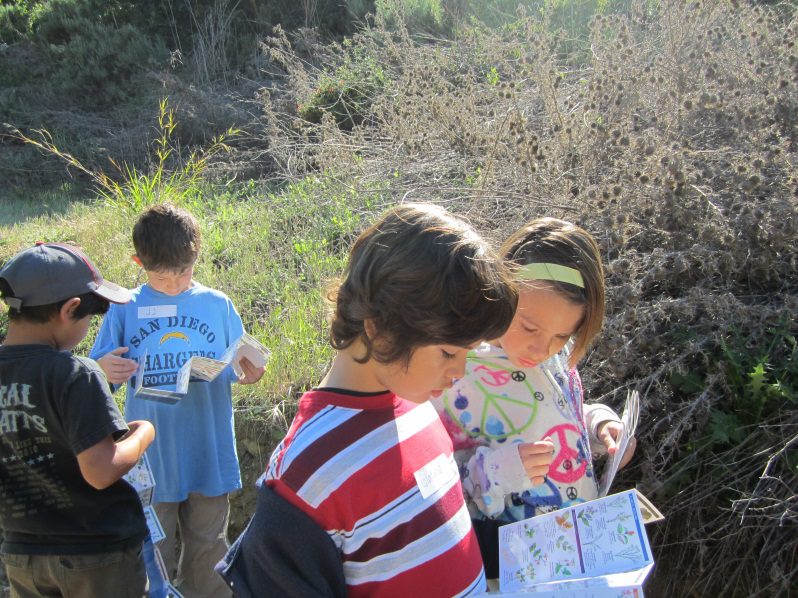
Students consult their field guides on a Nearby Nature walk.

It is easy to see that the staff members here at I Love A Clean San Diego are all fervent environmentalists.  I can confidently say that this enthusiasm is due in no small part to our unique childhood experiences in the great outdoors. Richard Louv, author of Last Child in the Woods: Saving Our Children from Nature-Deficit Disorder, maintains that a child’s experience in nature is vital to his or her development.  Studies have shown that youth who spend time outside are happier, healthier, and are better at learning than those who spend most of their time indoors.  ILACSD’s Nearby Nature program allows our educators to help youth connect with nature by leading them on an outdoor walk through a natural area close to their school.  We recently had the opportunity to take elementary students from two very different schools out of the comfort of their classrooms and into the wild.

Our first group of students was from John Muir Elementary, a school with a rather serendipitous name located next to Tecolote Canyon Natural Park.  After a short set of instructions and a safety talk in the classroom, we led the students out the door and down into the canyon. It was cool and invigorating early in the morning, and I was amazed to hear that many students had never been to the canyon before, despite its proximity to the school.
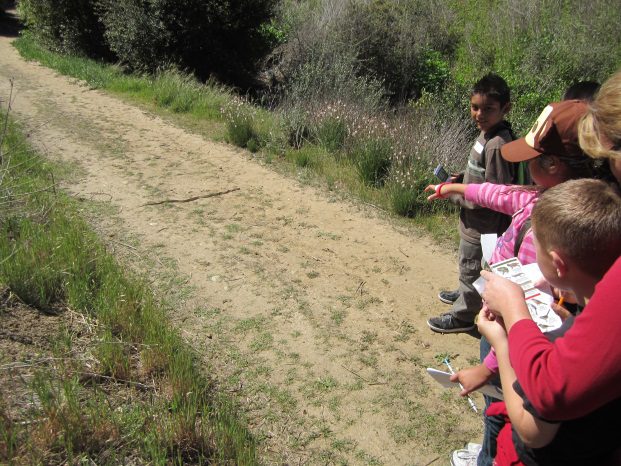
We handed all of the students a field guide with colorful pictures of San Diego’s native species. They used the guides throughout the walk to identify the plants and animals that we saw during the short walk through the canyon.  The most exciting part of the adventure was when one group walked around a corner and saw a three-foot long snake lying across the middle of the trail not five feet away!  After everyone had calmed down, the students looked up the reptile in their naturalist guides and identified it as a harmless Gopher Snake. We all breathed a collective sigh of relief.

Back in the classroom, the students showed each other leaf rubbings that they had done and swapped stories about the different plants, animals and flowers that they had seen on the hike. Before we left, I asked my group if they were going to visit the canyon again with their parents.  A loud, “yeah!” evidenced their enthusiasm. The ILACSD Educators all left the school with satisfied smiles.

We drove all the way to James Dukes Elementary School in Ramona a week later. The school is in a comparatively rural location, but again I was surprised to hear that the majority of the students hadn’t yet explored the nearby greenbelt.
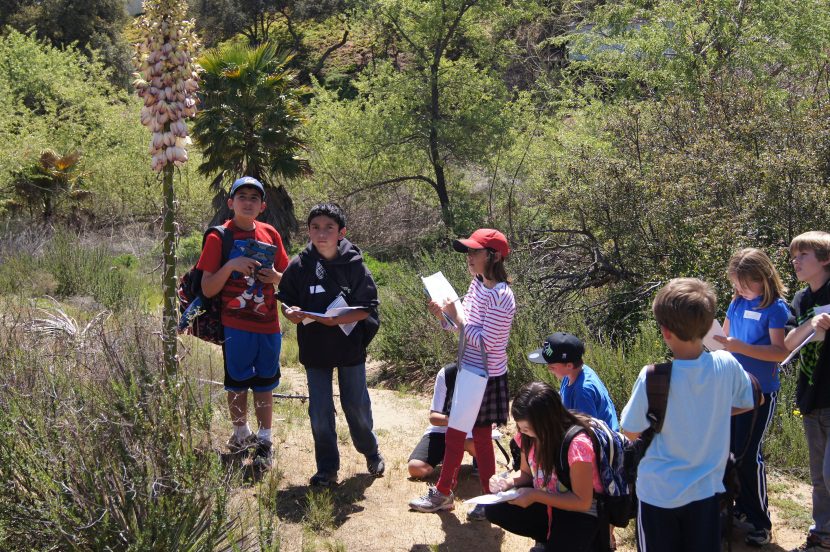
Students drew a picture of a yucca plant in their notebooks.

The kids had just learned about Kumeyaay culture, and were excited to tell us about how the Native American tribe had used elements from the surrounding environment to survive. The students became the teachers when they told us educators about how the Kumeyaay made sandals out of Yucca and Agave fibers, crafted pots out of clay, and ground up California Live Oak acorns to make most of their food.

Exhausted after the hike, the students collapsed in their chairs in the temperature-controlled classroom and filled out a short survey. The survey only had three questions: what the most interesting thing they saw on the hike was; one thing they learned; and what nature means to them. Their responses were all honest and heartening. Nature was described as awesome, special, wonderful, interesting, and in the words of one fourth grader, “calming. Any time I go into nature I feel safe.”

The Nearby Nature program is one of the most rewarding for us as educators. While we do enjoy teaching young students inside the classroom, it is extra satisfying to watch them get excited at seeing the native plants and animals in their neighborhoods.  The statistics do reveal that kids these days are missing out on the benefits of experiencing nature, but it pleases me to know that there are at least a few children in San Diego who have had the chance to explore a beautiful natural area in their neighborhood.

If you are a 3rd – 6th grade teacher in San Diego County who is interested in having your students participate in the Nearby Nature program next year, please contact our Education department at education@cleansd.org.
Kids Take A Stand in the Sand at Kids’ Ocean Day

Today’s post comes from ILACSD Environmental Educator, Alex Mullen-Ley.

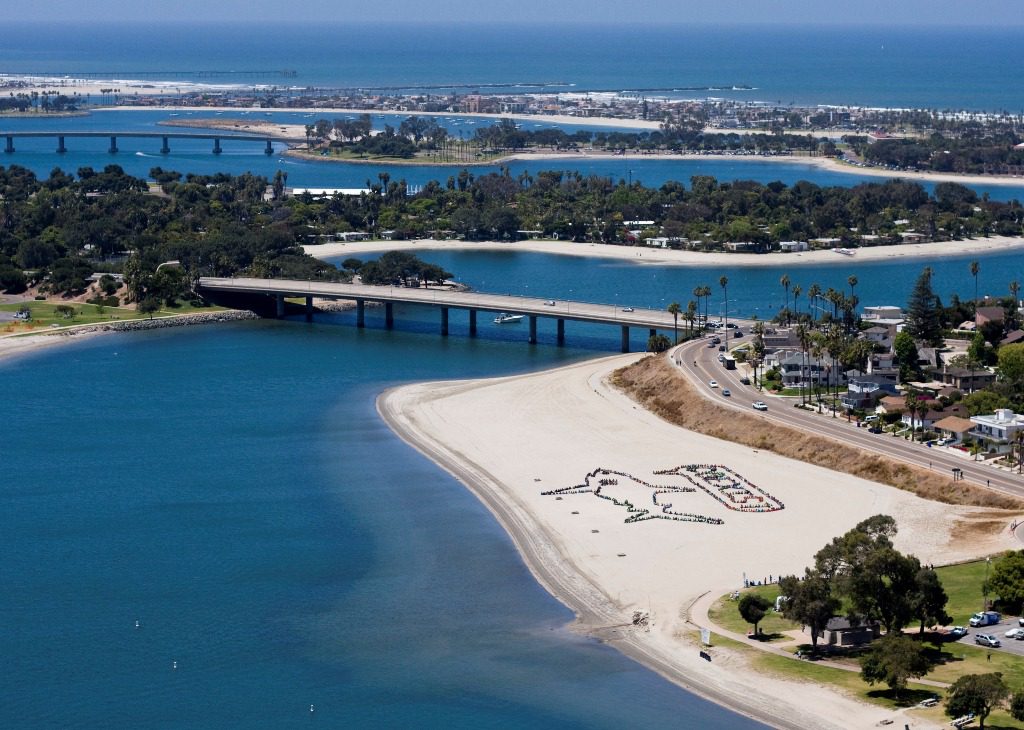
Kids’ Ocean Day 2011 Aerial Art

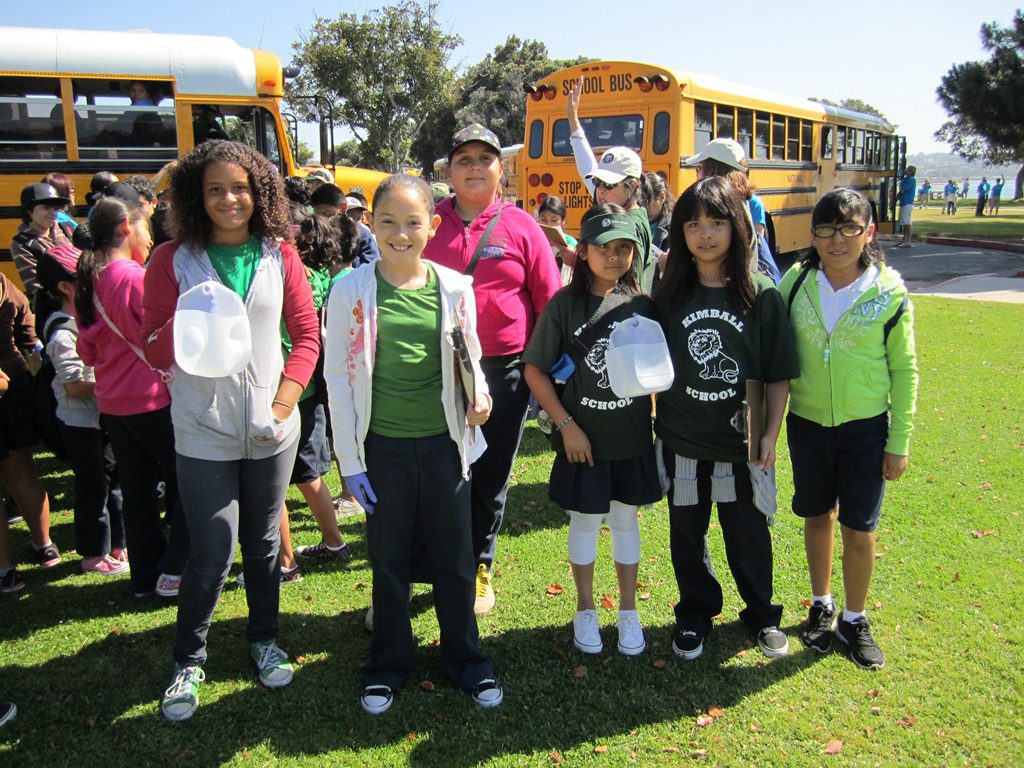
It’s hard to imagine that there are children here in San Diego who have never been to the beach before. Many of us take for granted that when it gets hot outside, everyone heads to the coast. One of I Love A Clean San Diego’s upcoming educational programs is giving underserved youth the chance to visit the beach for the very first time.  

On June 7th, as part of the 19th annual Kids’ Ocean Day Adopt-A-Beach Cleanup, ILACSD is coordinating nearly 900 students from eight Title I schools to help clean up the beach and make a visual statement in the sand about their concern for the future of the oceans. This is the third year that ILACSD will be holding the event at Crown Point Shores, and the ninth year that we have acted as the regional coordinators. 

The annual event started in Los Angeles in 1994 by the Malibu Foundation for Environmental Education and the California Coastal Commission. The original goals of the program were to increase public awareness of ocean issues and to connect children to the marine environment.  Over the past 18 years, the event’s range has expanded to include 7 cities along the California coast. 

During the month of May, ILACSD’s educators will visit each school to give the students a presentation about the importance of minimizing our impact on the marine environment and to get them excited to participate in the aerial art project.  We will meet them again at the beach on June 7th.  At last year’s event we had almost 200 students attend who experienced the beach for the first time, and we expect to have a similar number this year.  The theme for this year’s Kids’ Ocean Day is “Defend the Sea.” We are keeping the aerial art design a secret for now, but we can say that it will be an exciting first in the program’s history!

We are still looking for adult volunteers to help with the event from 8:00am to 1:00pm. If you are interested in signing up to volunteer, please contact Jemma De Leon at jdeleon@cleansd.org.

5,800 Volunteers + 150,000 Pounds of Trash = a Cleaner San Diego

Today’s post comes from ILACSD’s Marketing Intern and USD student, Maddy Blake. Updated 5/3/2012 with new totals!

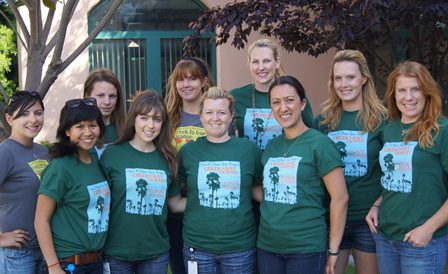
ILACSD’s Staff ready for the big day!

I Love A Clean San Diego celebrated its 10th annual Creek to Bay Cleanup this past Saturday, April 28th. An amazing 5,800 San Diegans joined together across the county to preserve and beautify their local environment. This year also marks the San Diego Girl Scouts’ 100th anniversary, over 1200 of scouts took part in the cleanup to show their commitment to the environment and witness the effects that pollution has on their communities.

Volunteers separated trash and recyclables.

Thanks to all of these fantastic volunteers, San Diego is a much cleaner county. In fact, more than 150,000 pounds of trash and debris were removed from local parks, canyons, creeks, bays and beaches in the span of just three hours! As in years past, cigarette butts and plastic bags were among the most common items found, but this year, some of the most interesting items our volunteers picked up were a rocking horse, a bowling pin and a five-gallon container of pickles.

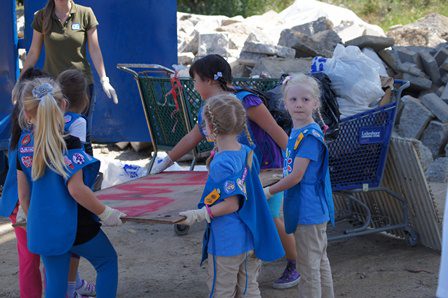
Daisy scouts pitch in at Creek to Bay.

With a total of 88 cleanup sites, the most we’ve ever had for Creek to Bay, there was somewhere for everyone to go and something for everyone to do. This year, cleanup events were held at five brand new sites in communities we hadn’t reached yet:

  • Paradise Hills – 40 volunteers filled an entire roll-away dumpster of debris
  • Spring Valley – 49 volunteers collected over 260 pounds of debris
  • Santa Ysabel – 20 volunteers removed 200 pounds of debris
  • Banker’s Hill – 49 volunteers removed 250 pounds of debris
  • University Heights – 32 volunteers can boast removing 1,200 pounds of debris

You read that right, at the site known as Camelot Canyon (the area beside the 163 at the Vermont St. bridge in University Heights), volunteers picked up 1,200 pounds of debris in that three hour timeframe and unfortunately there is more work to be done in that area. The site was brought to our attention by local University Heights resident, Alison Whitney, who bikes past the canyon on her way to work everyday. With the help of CalTrans and ILACSD, Alison organized this cleanup to make this corner of her community a little more enjoyable for local residents. Click here to read Alison’s interview with KPBS.

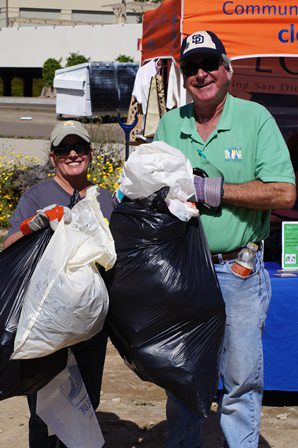
Just a sample of some of the debris picked up.

While about 40% of this year’s cleanup sites were in coastal areas, cleaning up inland sites like Camelot Canyon ensures that the trash will not travel down the watershed system and end up in our waterways, bays and the ocean. Furthermore, by expanding into the five new sites, an additional 2,000 pounds of debris were removed from the environment! After ten years, I Love A Clean San Diego still dedicates itself to county-wide programs and expanding its reach even farther to preserve and ensure a healthier San Diego for everyone.

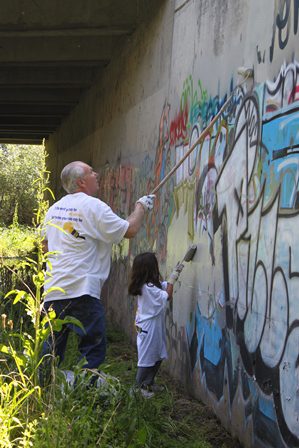
Volunteers painting over graffiti near Fashion Valley Mall.

Picking up trash is not the only activity our volunteers participated in – many sites included other beautification projects such as graffiti removal, mural painting, native planting, brush maintenance and other general park maintenance.

Don’t forget – if you joined us at Creek to Bay this year, remember to submit your favorite photo to ILACSD for our Sony Volunteers In Action photo contest! Photos are due on May 4, 2012, then the top 3 photos will be posted on our Facebook page, where our fans will vote for their favorite. The winner will be announced on May 18th! Click here for more details.

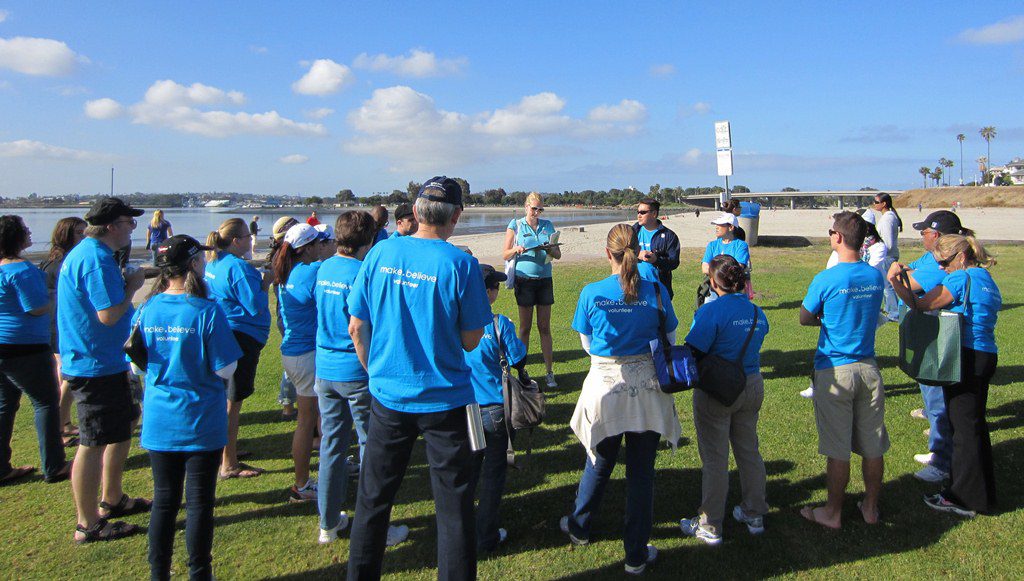
We want to thank ALL of the volunteers who took time out of their weekend to do more with their morning at the 10th Annual Creek to Bay Cleanup! We’d like to give a special thank you to the following volunteer groups who came out to show their love for a clean San Diego:

  • Local members of The Church of Jesus Christ of Latter-day Saints, Mormon Helping Hands Service Day
  • Girl Scouts, San Diego-Imperial Council
  • Sony
  • Gothic Volunteer Alliance
  • Torrey Pines Elementary School
  • Palabra Miel Oceanside
  • Vista Magnet Middle
  • Palquist Elementary School
  • Palomar College TRiO
  • New Haven Youth and Family Services
  • Temecula Kids for Peace
  • PASS AmeriCorps
  • Nokia
  • Ramona High School Fusion
  • Toler Elementary School
  • Starwood San Diego
  • LEVI
  • Chula Vista Learning Community Charter School
  • Mueller Charter School
  • Pima Medical Institute
  • AMC Plaza Bonita 14
  • TSC San Diego
  • Pima Medical Institute
  • San Ysidro High School Surf Club
  • Montgomery Middle School

Video Post: Why is the Creek to Bay Cleanup Important?

Take a look at this great video created by our intern, USD student Maddy Blake, talking with the ILACSD staff and Creek to Bay site captains about why they love the Creek to Bay Cleanup and why it is an important part of keeping San Diego clean:

 
[youtube http://www.youtube.com/watch?v=A9QCAWJdSro]

We are so excited to celebrate the 10th anniversary of this great event! Do more with you morning, sign up to volunteer this Saturday, April 28th from 9am-12pm at any of our 86 cleanup sites around San Diego County: www.CreektoBay.orgvolunteers are especially needed at our 47th St. Canyon (City Heights) site and our kickoff site along the San Diego River behind Fashion Valley Mall!

Lights, Camera, Action!

Today’s post comes from Morgan Justice-Black, ILACSD’s Director of Development and Marketing!

Charge those camera batteries and get ready to compete in the Sony Creek to Bay photo contest! I Love A Clean San Diego and Sony challenge you capture the spirit of the Creek to Bay Cleanup by taking photos of volunteers in action on Saturday April 28th. Whether you’ve got a fancy camera or a cell phone, you could be the winner of a brand new Sony Cyber-Shot camera if your picture makes the final cut!
Here’s how to do it:

  1. Volunteer at the Creek to Bay Cleanup on Saturday April 28th from 9am – 12noon (register on the event website: www.creektobay.org)
  2. While you’re cleaning up at the event, take a moment to capture your best “volunteer in action” shot from your site. It may be you, a friend or someone who looks like they are giving their all for a cleaner environment. Just make sure that the image captures the spirit of the Creek to Bay Cleanup!
  3. After the cleanup, submit your best photo via email to iloveacleansd@gmail.com. Please include your name, phone number and email address so that we may contact you if you are the winner. All entries must be submitted by Friday May 4th.
  4. I Love A Clean San Diego staff will narrow down the field to three finalists, whose photos will be posted on ILACSD’s Facebook page for voting May 11-May 17.
  5. Encourage your friends to “like” ILACSD’s Facebook page and vote for their favorite picture. Voting will go through May 17.  (www.facebook.com/iloveacleansd)
  6. Cross your fingers, because we will announce the winner on Friday May 18th!

Volunteer Spotlight: Brent Carter

We are less than two weeks from I Love A Clean San Diego’s 10th Annual Creek to Bay Cleanup! With over 5,300 volunteers last year, our amazing site captains are vital in guaranteeing the success of this countywide event. This year they are taking the lead at 88 sites across San Diego County and ensure that their volunteers have everything needed for a successful cleanup.

This week is also National Volunteer Appreciation Week and it couldn’t have come at a better time! We’ll be recognizing many of our amazing volunteers throughout the week so if you haven’t already, make sure you’re following us on Facebook and Twitter.

Today’s Spotlight: Creek to Bay site captain, Brent Carter!

Brent first reached out to ILACSD four years ago because he needed supplies for a cleanup he was organizing in a canyon near his home. He quickly decided to become a volunteer site captain at our Creek to Bay Cleanup, leading volunteers to beautify the 47th St. canyon site. Brent says that Creek to Bay is an important event because “bringing attention to urban sites that have been forgotten is essential, and Creek to Bay does that in a great way. It is easy to forget the pathway of debris, from the watersheds in the canyon, down to the sea.  It also a great way to get people out of their homes or routines and make some new friends on a wonderful day of stewardship!” 

All of us here at ILACSD want to thank Brent for his dedication to keeping his backyard canyon and our watersheds clean!

Full Q & A with Brent Carter:

What motivated you to volunteer with ILACSD?

I had been doing cleanups and restoration in the canyon near where I live, and heard about ILACSD from community leader, Linda Pennington.  She said ILACSD had helped her do events and helped organize, bring volunteers and provided equipment.  I can say that they have been so organized and helpful.  They essentially provide an “event in a box,” which is heaven-sent for a small group leader like myself.

How long have you been volunteering with ILACSD? 

Four years (ish)

How long have you been a site captain for Creek to Bay?

Four years (ish)

Have you always been a captain at the same site (47th St. canyon)? 

Yes, although I helped manage five sites for Coastal Cleanup Day last year.

Why is that site important to you? 

I live on the edge of the canyon and walk my dog there every day.  There are five of us with dogs that pick up trash and patrol the canyon each morning!  Keeping it clean, restored and safe is a priority to me.

What is your favorite part of participating in the Creek to Bay cleanup?

From start to finish, this is a great event.  ILACSD helps bring volunteers, gives advice, and provides equipment. I wish every organization I have worked with was so professional and on the ball!  Working with such surprising and varied volunteers is awesome, then walking through the site looking at how effective everyone has been is wonderful.

Why do you think cleanups like Creek to Bay are important to keeping San Diego healthy and clean?

Bringing attention to urban sites that have been forgotten is essential and Creek to Bay does that in a great way.  It is easy to forget the pathway of debris, from the watersheds in the canyon, down to the sea.  It also a great way to get people out of their homes or routines and make some new friends on a wonderful day of stewardship!

What is the strangest piece of trash you’ve found at a Creek to Bay Cleanup?

Strangest thing EVER is: four baby teeth in a little box.  I still have not figured out how they got in a canyon – any ideas? It’s odd, just odd.

Volunteer Spotlight: Maruta Gardner

Today’s post was written by Maddy Blake, ILACSD’s Marketing Intern.

MarutaGardner
Maruta, left, with volunteers at Creek to Bay

To continue our celebration of the 10th anniversary of our signature event, the Creek to Bay Cleanup, this week’s volunteer spotlight is Maruta Gardner! Although Maruta began volunteering with I Love A Clean San Diego fourteen years ago, she fully dedicated herself to the organization by becoming a site captain for Santa Clara Point eight years ago and has been returning annually ever since. Located in Mission Beach, Santa Clara Point houses the Mission Beach Women’s Club, an organization that Maruta has been involved in for many years.

Like many of our site captains, Maruta resides in the same area that she oversees during the Creek to Bay Cleanup. This gives the captains a sense of personal responsibility towards their specific location and the overall success of the cleanup event. They, like Maruta, value their local community and want to ensure that its beauty and cleanliness are available for everyone to enjoy. By becoming a site captain, Maruta chose to become accountable for the Mission Beach area and the place she’s called home for so many years.

Maruta says that her favorite thing about being involved with the Creek to Bay Cleanup is, “seeing all of the parents who bring their kids to start them early on the path to community service.  It’s also great to see all of the student groups working together to improve the neighborhood.”

Full Q&A with Maruta

What motivated you to volunteer with ILACSD?   

For the 22 years we have lived in Mission Beach,  my husband and I have been involved in the community in numerous ways.  Keeping the beach clean has always been a high personal priority.  We were going around picking up trash on our own but when we learned about the efforts of ILACSD, we saw how effective the work of a group can be.

How long have you been volunteering with ILACSD?

At least 14 years on a regular basis.

How long have you been a site captain for Creek to Bay? 

8 years.

Have you always been a captain at the same site?

I have been an active member of the Mission Beach Women’s Club for many years.  MBWC is located at Santa Clara Place and Bayside Walk.  Santa Clara Point has been a clean up site for ILCASD and that’s where I started being a site captain.  We want to keep the neighborhood around the club clean for all to enjoy.

What is your favorite part of participating in the Creek to Bay cleanup?

The best part is seeing all of the parents who bring their kids to start them early on the path to community service.  It’s also great to see all of the student groups working together to improve the neighborhood.

Why do you think cleanups like Creek to Bay are important to keeping San Diego healthy and clean?

The cleanups bring awareness to the entire community about the negative effects of trash on our environment. They also encourage citizens and kids to get involved in making community improvements.

What is the strangest piece of trash you’ve found at a Creek to Bay Cleanup?

We mostly get tons of cigarette butts and food wrappers.  We’ve also had discarded underwear, shoes, and toys.  Nothing exotic.

Washed Ashore: Plastics, Sealife and Art

Whale skelton made of plastic bottles

Updated October, 8, 2012.

As many of us know, today’s marine life is threatened by the multitude of plastics that make their way into our oceans and endanger sea creatures and their habitats. Artist and educator Angela Haseltine Pozzi understands this reality all too well and as a result, began an amazing project to not only showcase the types of trash found within our oceans, but also to encourage individuals to think twice before polluting our environment.

“The Washed Ashore community project aims to educate and create awareness about marine debris and plastic pollution in art.” It began in Oregon after hundreds of volunteers collected over 7,000 pounds of trash in order to create larger-than-life sculptures. This clean-up event brought people together to create awareness about the problems that marine debris causes. There are fifteen huge sculptures in total! Some include a coral reef made completely from Styrofoam, jellyfish created from plastic bottles, and a giant, musical sea star.

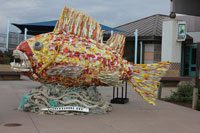
Henry the fish, made of assorted plastic pieces that volunteers collected and sorted by color.

Since Washed Ashore debuted in Oregon, it has started a global tour to teach communities to change their potentially hazardous bad habits. Today, you can find it at the the Living Coast Discovery Center in Chula Vista! Not only will you be able to witness these gigantic sculptures first-hand, but you’ll also have the opportunity to listen to special guest speakers and participate in field trips and art workshops. It’s an interactive and fun way to learn about how human interaction can be detrimental to our oceans.

The ILACSD Staff visited the exhibit and posed in front of “Lidia” a seal made mostly of plastic lids found on Oregon’s shores.

The ultimate hope for the Washed Ashore project is global action “to create a stream of events, discussions and awareness that lead to active solutions.” The exhibit has been extended and will be on display through September 3rd, 2012 at the Living Coast Discovery Center located at 1000 Gunpowder Point Drive in Chula Vista. We encourage you to check out the fun and visit www.washedashore.org for more information.

Volunteer Spotlight: Bob and Jan Rogers

For many years, Bob and Jan Rogers saw a need for beach cleanups and public awareness about clean water in their local community. Since 2004, the couple have been site captains at Beacon’s Beach for ILACSD’s annual Creek to Bay Cleanup and have even involved their family in the fun. “When we first started with the beach cleanup program, our sons were part of the volunteers cleaning the beach. They are now married and our son, Jesse, and his wife work as our bilingual co-captains. Our son, Randy, and his wife, Virginia, also help out as volunteers – they now have a daughter, Sierra, and she is also part of the beach cleanup crew.”

Because the family spends so much time together at Beacon’s Beach (and it’s Bob’s favorite surfing location!), they realize the importance of keeping the water clean and safe and value being a part of this volunteer effort every year.

One of the main goals of the Creek to Bay Cleanup is for residents to gain a sense of ownership of the local environment, especially by teaching the next generation of San Diegans the importance of keeping our community clean. Bob and Jan say, “It’s a  great learning experience for the kids. A friend of ours brought her son to Beacon’s years ago and now wherever they go to the beach he picks up trash. They are the stewards of the environment.” The Rogers family also encourages all of the volunteers at their site to bring their own reusable supplies, like gloves and buckets, so that they aren’t producing more waste by using plastic bags and latex gloves at the cleanup.

All of us here want to thank Bob, Jan and the entire Rogers family for dedicating their time each year to cleaning their local beach and spreading awareness about the importance of keeping San Diego clean to their community!

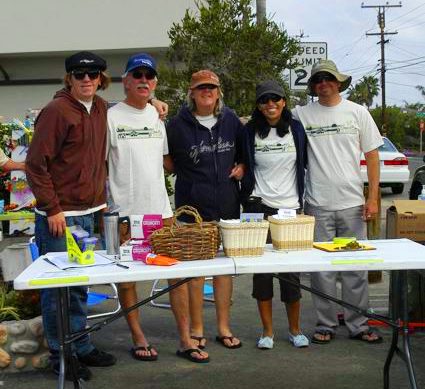
The Rogers Family!

What motivated you both to volunteer with ILACSD?

We moved to Leucadia in ’96 and saw the need for beach cleanups and public awareness about clean water.  We love the beach and feel we all have a responsibility to give back.

How long have you been volunteering with ILACSD?

In 1998 we organized our first beach cleanup at South Pontos.  Surfriders sent us to Coastkeepers and from there we made contact with ILACSD.  With each group we’ve met friends that share our interest in the environment.

How long have you been a site captains for Creek to Bay?

We have collected some of the posters from our beach cleanups.  After checking the posters we figured we began around 2004.

Have you always been a captain at one particular site?

We captain Beacon’s Beach for Creek to Bay, South Pontos for “Day After the Mess” and back to Beacon’s Beach for the Sept. Coastkeeper International Beach cleanup.

Why is that site important to you?

This is our neighborhood beach.  It attracts families so we get a lot of children at the cleanups.  Bob also surfs Beacon’s.

What is your favorite part of participating in the Creek to Bay cleanup?

The returning people that come back year after year and the kids.

Why do you think cleanups like Creek to Bay are important to keeping San Diego healthy and clean?

It’s a vehicle for getting the word out about keeping beaches and our waterways clean.  It’s a  great learning experience for the kids.  A friend of mine brought her son to Beacon’s years ago and now wherever they go to the beach he picks up trash.  They are the stewards of the environment.  It’s a great event.

What is the strangest piece of trash you’ve found at a Creek to Bay Cleanup?

Led Zepplin album and a jar of pickles (?).  In the future, it would be nice to see no balloons, cigarettes and plastic trash bags.  Also, volunteers bringing their own supplies to cut down on the debris we generate.

We love doing this.  It is so rewarding.

Registration for ILACSD’s annual Creek to Bay Cleanup is now open at www.creektobay.org. Out of the 86 cleanup sites around San Diego county, there’s bound to be one near you! Join us on Saturday morning, April 28th to be a steward of the environment and do more with your morning.

Future of water on display for San Diego’s Water Purification Demonstration Project

Today’s guest post comes from Marsi Steirer, Water Purification Demonstration Project Director at the City of San Diego, Public Utilities Department.

In summer 2011, the City of San Diego opened its doors to a facility that is testing whether it can provide a new, local source of water for San Diego. Located in northern San Diego, the Advanced Water Purification (AWP) Facility is a small-scale, state-of-the-art facility that purifies one million gallons of recycled water every day to a level similar to distilled water quality. Since opening, hundreds of people from all over the world have toured the AWP Facility which is one component of the City’s Water Purification Demonstration Project that is examining the safety and cost of purifying recycled water. If this project is approved to go full-scale, the purified water would blend with imported supplies at San Vicente Reservoir and become part of the City’s drinking water supply. Throughout this entire test phase, purified water is not sent to San Vicente Reservoir or the City’s drinking water system; instead, it is added to the City’s existing recycled water system.

San Diego is examining water purification as a means to develop a locally controlled, supplemental water supply. San Diego’s semi-arid region is at the end of pipelines that bring imported water from hundreds of miles away. The City needs to develop local, reliable water sources to lessen its dependence on expensive and limited imported water supplies.
 
“Our City has been both creative and aggressive in trying to diversify our water supply. The less we rely on importing water from outside San Diego County, the more we control our own destiny,” San Diego Mayor Jerry Sanders said. “A locally produced supply of water could be an important option for us.”

All wastewater in San Diego undergoes treatment to remove harmful contaminants, making it safe enough to be discharged into the ocean.  Some wastewater is diverted to the City’s recycled water facilities, where it is further treated and then used for irrigation and industrial purposes. A portion of the recycled water produced at the North City Water Reclamation Plant is sent to the AWP Facility.

To become purified water, the recycled water undergoes a multi-barrier purification process, which removes or destroys all unwanted materials in the water and produces one of the purest supplies of water available anywhere.  The process also includes continuous water quality monitoring where the City thoroughly examines the safety of the water through laboratory tests and computer analysis to ensure that it meets drinking water quality standards.

The results of the project’s data collection will determine the safety and cost of a full-scale water purification and reservoir augmentation project. After the test phase is complete, the Mayor and City Council will decide on implementing a full-scale project.

“This Demonstration Project will provide the answers San Diego needs before taking the next step with purified water,” said Mayor Sanders. “We owe it to our citizens to see if we can come up with an alternative source of local, safe and relatively inexpensive drinking water.”

The same water purification process is already used around the world from Singapore to Belgium to Australia. Just north of San Diego, Orange County operates the world’s largest water purification plant. The Orange County Groundwater Replenishment System produces up to 70 million gallons a day of ultra clean water for nearly 600,000 residents and for many businesses and attractions, including Disneyland. The purified water is injected into the county’s drinking water aquifer. This facility is being expanded to produce an additional 30 million gallons a day.

Visitors are encouraged to tour the City of San Diego’s AWP Facility to gain a better understanding of the Demonstration Project and what role the AWP Facility plays in the testing phase. At the end of the tour, guests view the purified water produced at the facility and have a chance to visually compare it to drinking water and recycled water samples.

Click here to register online for a tour or view a virtual tour of the AWP Facility online at www.purewatersd.org. To request a Demonstration Project presentation for an organization, email purewatersd@sandiego.gov or call (619) 533-6638.

For more information about the City of San Diego’s Water Purification Demonstration Project, visit www.purewatersd.org, email purewatersd@sandiego.gov, or call (619)533-7572.